AC Energy Cost Calculator: High SEER Savings in 2027
Enter your electric rate, AC size and SEER rating, and this calculator shows what your central air costs each summer, what a higher-SEER system would cost to run, the yearly savings and the installed price. You’ll see fast whether an upgrade pays off or the old unit has a few cheap summers left.
Calculate your AC energy costs & savings in Columbus, OH
- Current Energy Costs:
- $0 · 0 kWh
- New AC Energy Costs:
- $0 · 0 kWh
- Annual Savings:
- $0 · 0 kWh
Estimated New System Cost:
See costs in your area Start Here - Enter Your Zip Code
HOW WE GOT THESE NUMBERS: Cooling costs use the average Ohio electric rate of $0.233 / kWh + $0.025 = $0.258 / kWh. How many kWh you use and what a new system costs both depend on your Climate Zone #3. The map and BTU load table below show where you fall.
Here are current Ohio and US Average residential Electricity rates.
| State Average ( OH ) | US Average | |
|---|---|---|
| Electric Cost: | $0.233 / kWh | $0.217 / kWh |
How to Use the AC Energy Cost Calculator
1. Use your own electric rate. The calculator pre-fills your state’s average from federal (EIA) data, plus about 2.5 cents for fees. That can miss in both directions: municipal utility customers often pay less, and time-of-use customers (the default at California’s big utilities) pay more in the afternoon, right when the AC runs hardest. California’s peak rates can top $0.50 per kWh. To get your real rate, divide the total on your last bill by the kWh you used, then type it over the default. That number includes delivery charges.
2. Pick your system size. Choose the tonnage you have now, or the size your home actually needs. Find your region on the map, then look down that column of the table for your home’s square footage.
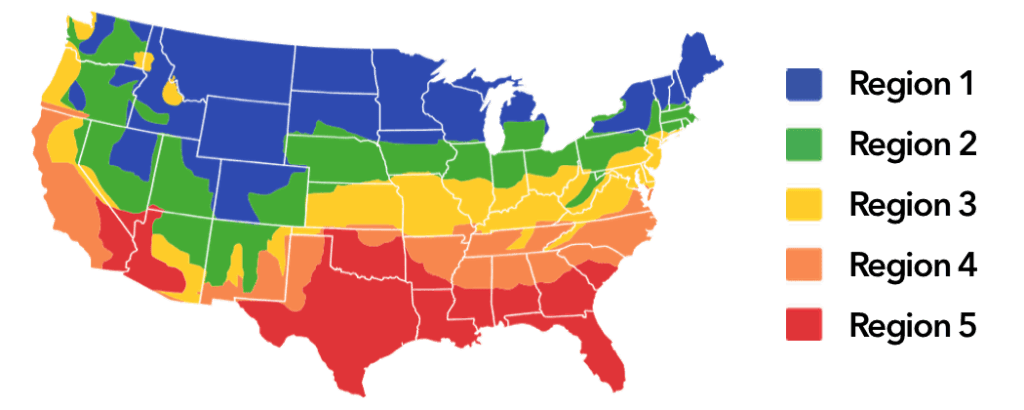
| AC size | Region 1 (blue) | Region 2 (green) | Region 3 (yellow) | Region 4 (orange) | Region 5 (red) |
|---|---|---|---|---|---|
| 1.5 ton | 700-1,100 | 700-1,050 | 500-1,000 | 500-950 | 500-900 |
| 2 ton | 1,101-1,400 | 1,051-1,350 | 1,001-1,300 | 951-1,250 | 901-1,200 |
| 2.5 ton | 1,401-1,650 | 1,351-1,500 | 1,301-1,500 | 1,251-1,550 | 1,201-1,500 |
| 3 ton | 1,651-2,100 | 1,601-2,000 | 1,601-1,900 | 1,501-1,850 | 1,501-1,800 |
| 3.5 ton | 2,101-2,300 | 2,001-2,250 | 1,901-2,200 | 1,851-2,150 | 1,801-2,100 |
| 4 ton | 2,301-2,700 | 2,251-2,700 | 2,201-2,500 | 2,151-2,500 | 2,101-2,400 |
| 5 ton | 2,701-3,300 | 2,751-3,300 | 2,601-3,200 | 2,501-3,100 | 2,401-3,000 |
Not sure the old unit was sized right? Check it with our AC tonnage calculator. Oversized systems are more common than you’d think.
3. Enter your current SEER. It’s on the outdoor unit’s data plate, or a quick search of the model number will turn it up. Can’t find it? Go by age: a unit installed before 2006 is probably 9 or 10 SEER, anything newer is at least 13, and today’s federal minimums are about 14 SEER in the North and 15 in the South.
4. Choose a new SEER to compare. For most homes, 16 SEER is the sweet spot: a big jump in efficiency without a big jump in price. From 17 SEER up, you’re mostly shopping heat pumps (more on that below). The 26 and 30 SEER options are mini-split numbers only, since no central system gets there. Past 1.5 tons, that means several single-zone units, because multi-zone mini-splits top out around 20-21 SEER.
5. Add duct insulation if your ducts need it. Bare, leaky ductwork in a hot attic can lose 20-30% of what your AC produces. Choosing R-6, R-8 or R-10 duct insulation here cuts the new system’s running cost by roughly 8-14%. Contractors sometimes bury duct work inside a replacement bid, so ask for it as a separate line item. Our ductwork cost calculator covers what that job runs.
6. Add wall insulation if you’re planning it. Going from standard R-13 walls to closed-cell foam (R-19 or R-32) trims the new system’s running cost by about 5-9%. Both insulation options change the savings only, not the equipment price.
7. Hit Calculate. You’ll get what your current unit costs per cooling season, what the new one would cost, the yearly savings, and a low, mid and high installed price. Season length and daily run hours come from your state’s climate zone, and any insulation savings are already folded in. Want real numbers for your house? Drop your ZIP in below the results for quotes from local HVAC contractors.
Quick Answers
Answers use Ohio averages; energy prices updated October 2026.
Is a heat pump cheaper to run than natural gas in Ohio?
Not in Ohio right now. Natural gas buys 63,517 BTUs per dollar; a heat pump at a COP of 3 buys 43,990. Power would have to drop below about 16.1¢ per kWh to flip that (the Ohio average is 23.3¢), or the heat pump would need a higher COP.
How does electricity in Ohio compare with the national average?
Ohio averages 23.3¢ per kWh, 7% above the U.S. average of 21.7¢ and the 16th highest of the 50 states and DC. AC and heat pump running costs rise and fall with that rate.
Do I need a cold-climate heat pump in Ohio?
It’s a smart upgrade. With a statewide average winter low around 20°F, a standard heat pump handles most nights in Ohio, but cold snaps cut its output. A cold-climate model or a backup heat source covers those.
How much does a heat pump save over baseboard heat in Ohio?
At a COP of 3, about two-thirds. At the Ohio average of 23.3¢ per kWh, baseboard heat costs about $68.20 per million BTU; a heat pump delivers the same heat for about $22.73.
When is the best time to replace HVAC in Ohio?
Spring or fall, before you need it. Installers are busiest in the first heat wave and the first cold snap, and an emergency swap leaves no time to compare quotes.
Should I replace the furnace and AC at the same time?
If both are well into their life, usually yes: one crew visit, one labor bill, and a matched indoor coil and outdoor unit, which is what the efficiency rating assumes. If one of them is fairly new, price the jobs separately.
Run your own numbers: Central AC cost estimator or Heat pump cost calculator.
 See Costs in Your Area!
Start Here - Enter your zip
HVAC Costs in Ohio
Typical installed prices in Ohio, equipment and labor.
How Much Does a High-SEER AC Save Per Year?
For a typical 3-ton house, going from an old 9 SEER unit to a 16 SEER central air system saves roughly $600-$650 a year at the national average electric rate.
Where power is pricey (California, New Jersey, Massachusetts and similar), that climbs to roughly $1,000-$1,800 a year. Same equipment, same house. Only the rate per kWh changed, which is why that field matters more than any other.
How Much Electricity Does Central Air Use?
BTUs tell you how much heat an AC pulls out of the house per hour. SEER tells you how efficiently it does it. Divide one by the other and you get the compressor’s power draw:
BTUs ÷ SEER = watts
One ton equals 12,000 BTUs, so a 3-ton unit is 36,000 BTUs and a 5-ton is 60,000. Always convert tons to BTUs before you do the math.
Worked example: a 3-ton, 14 SEER system
This is about as common as central air gets in the US. 36,000 ÷ 14 = about 2,570 watts, or 2.57 kW, for the compressor. The indoor blower adds 250 to 600 watts depending on age and size. Call it 400, and the whole system draws close to 3 kW.
For Florida and other hot-zone states, the calculator figures a 155-day cooling season with the AC running about 16 hours a day:
16 hours × 3 kW × 155 days = 7,440 kWh
At around $0.15/kWh, that’s roughly $1,100 for the season.
The same system at Hawaii’s electric rates
In Hawaii, where power runs close to $0.50/kWh, the same 7,440 kWh costs about $3,600.
And Hawaii doesn’t have a cooling season. It has a cooling year: highs in the mid-80s, lows in the low 70s, barely changing month to month. The AC might run only 8 hours a day, but it runs every day: 8 × 3 kW × 365 = 8,760 kWh, or about $4,200 a year.
Swap in a 20 SEER heat pump and the draw drops to about 2.2 kW (1,800 watts for the compressor plus the blower). The yearly bill falls to roughly $3,100. That’s about $1,100 a year back in your pocket.
When a High-SEER Heat Pump Is Worth the Extra Money
Most 17+ SEER equipment is a central heat pump, and it does double duty: cooling in summer, whole-house heating in winter. In milder climates (map regions 3 through 5 above) it can heat the house without a natural gas furnace or electric strip backup.
The catch is cost. A 4-ton, 18 SEER heat pump runs about $17,340-$20,550 installed depending on region, roughly $8,250-$9,780 more than a basic 14 SEER AC of the same size. My rule of thumb: if you pay less than about $0.26/kWh, cooling savings alone take too long to pay that back. Above that, it starts to make real sense.
Check for rebates before you sign anything. Many states and utilities offer rebates or tax incentives for Energy Star central and ductless systems, and some pay by the ton. Massachusetts is a standout, with especially generous money if you’re moving off oil or propane heat. In the best cases, rebates pull a high-SEER heat pump down close to what a bare-bones AC would cost. Add $1,000 or more a year in cooling savings in a high-rate area, and the premium over a basic AC can come back in a few summers.
For a straight price on standard equipment, our central air installation cost calculator breaks it down by size and region.
Is Upgrading From 13 SEER to 16 SEER Worth It?
Usually, if your old unit is near the end of its life anyway. On a 3-ton system, 16 SEER runs roughly $2,080-$2,460 more than a basic 14 SEER, and at the national average rate it saves roughly $90-$100 a year over the 14. That gap takes over twenty years to come back at average rates, faster where power is expensive. Replacing a working 13 SEER system purely for efficiency is harder to justify unless your rates are high.
Comparing running costs on a ductless system instead? Our ductless heat pump energy cost calculator works the same way, and the HVAC load calculator double-checks the size before you buy.
Ready to see real prices? Get free quotes from local HVAC contractors and compare them against your calculator results.
 See costs in your area
Start Here - Enter Your Zip Code