AC Tonnage Calculator 2027: What Size Central Air Do I Need?
This AC tonnage calculator works out how many tons of central air your house needs from its square footage, climate region, insulation and the SEER rating you want, then adds a ballpark installed price. Get this number before you call contractors. It sets your equipment cost, your summer power bills and how sticky the house feels in August.
Central AC Size in Columbus, OH
- BTU Load (Tons)
- 0 BTU (0 Ton Central AC)
Estimated New Central AC Cost:
See costs in your area Start Here - Enter Your Zip Code
How to Use the AC Tonnage Calculator
The four fields on top do most of the work. The four under Show More Options fit the result to your particular house, so open them if you have a minute.
- Home Size: only the square footage you actually cool. Leave out the garage, the attic and an unfinished basement unless people live in them.
- AC SEER Rating: this is efficiency, not capacity. A 3-ton house needs 3 tons at 14 SEER or 20 SEER; the rating only changes the price and the running cost. Pick 18+ and the result switches to a central heat pump, because nearly every system that efficient is one.
- Wall Insulation: a house with 2×4 walls usually has R-13 in them, which is the average setting. Newer 2×6 walls get the R-18 option. If some walls were never insulated, go lower.
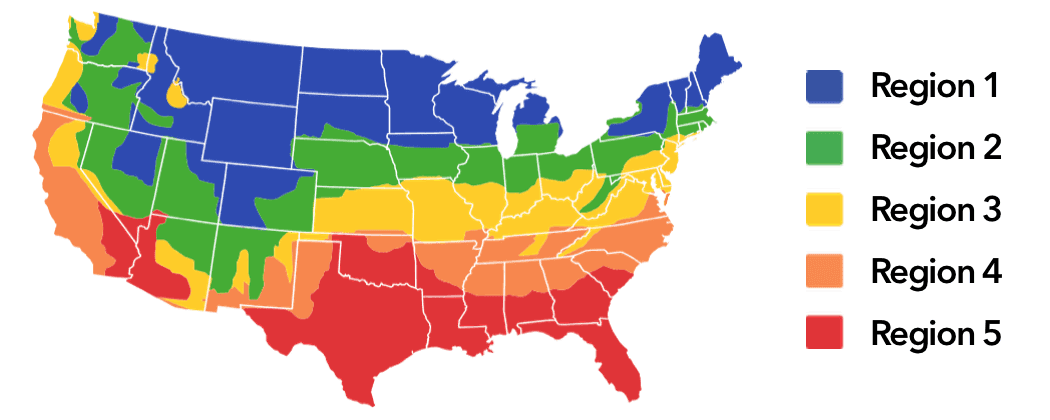
- Climate Region: filled in from your location. Check it against the color map in the sizing chart section below. Going from the coolest region (blue) to the hottest (red) adds about 20% to the cooling load, so it’s worth getting right.
- Ceiling Height: starts at 9 feet. Each foot over 8 adds about 6% to the load. For a vaulted room, average the low wall and the peak.
- Air Tightness, Windows and Sun Exposure: single-pane windows, lots of glass or a house that bakes in full afternoon sun all push the size up. Mature shade trees bring it down.
Hit Calculate. You get the unit size first, then an installed price that assumes you’re replacing an old system and keeping the ductwork you have. New ducts cost extra (see the cost section below). If a contractor quotes a full ton more than your result, ask how they got there.
Quick Answers
Answers use Ohio averages; energy prices updated October 2026.
Is a heat pump cheaper to run than natural gas in Ohio?
Not in Ohio right now. Natural gas buys 63,517 BTUs per dollar; a heat pump at a COP of 3 buys 43,990. Power would have to drop below about 16.1¢ per kWh to flip that (the Ohio average is 23.3¢), or the heat pump would need a higher COP.
How does electricity in Ohio compare with the national average?
Ohio averages 23.3¢ per kWh, 7% above the U.S. average of 21.7¢ and the 16th highest of the 50 states and DC. AC and heat pump running costs rise and fall with that rate.
Do I need a cold-climate heat pump in Ohio?
It’s a smart upgrade. With a statewide average winter low around 20°F, a standard heat pump handles most nights in Ohio, but cold snaps cut its output. A cold-climate model or a backup heat source covers those.
How much does a heat pump save over baseboard heat in Ohio?
At a COP of 3, about two-thirds. At the Ohio average of 23.3¢ per kWh, baseboard heat costs about $68.20 per million BTU; a heat pump delivers the same heat for about $22.73.
When is the best time to replace HVAC in Ohio?
Spring or fall, before you need it. Installers are busiest in the first heat wave and the first cold snap, and an emergency swap leaves no time to compare quotes.
Should I replace the furnace and AC at the same time?
If both are well into their life, usually yes: one crew visit, one labor bill, and a matched indoor coil and outdoor unit, which is what the efficiency rating assumes. If one of them is fairly new, price the jobs separately.
Run your own numbers: Central AC cost estimator or Heat pump cost calculator.
HVAC Costs in Ohio
Typical installed prices in Ohio, equipment and labor.
How Many Tons of AC Does My House Need?
Plan on one ton of cooling for every 500 to 600 square feet of living space. Use the 600 end for a newer, well-insulated home and 500 for an older house with leaky windows and thin attic insulation. Climate shifts it too: the same size unit will handle roughly 200-300 fewer square feet in Florida than in Montana.
Most single-family homes end up between 2 and 4 tons. Residential condensers run from 1.5 tons up to 5 tons, and anything past that is commercial equipment.
Getting it close matters because power isn’t cheap. Rates run roughly 14-18 cents per kWh across much of the South and 30 cents or more in California and much of New England. An oversized system wastes that money, and an undersized one leaves you hot.
To see what your current unit costs to run, try the AC energy cost calculator. Swapping a tired 9 SEER unit for a 16 SEER model can save several hundred dollars a year, more where summers are long and power is pricey, and a lot of utilities hand out rebates on top of that.
Tons vs. BTUs: What “Size” Really Means
AC size has nothing to do with how big the box is. It’s how much heat the unit can pull out of your house per hour, measured two ways:
- BTU (British Thermal Unit): the heat it takes to warm one pound of water by one degree Fahrenheit.
- Ton: 12,000 BTUs per hour. The name goes back to the cooling you’d get from a ton of ice melting over 24 hours.
So a “3-ton” system removes 36,000 BTUs of heat an hour, and sizing a home means working out how many BTUs (and how much airflow) it takes to hold the inside at about 75°F on a hot day.
Home units step up in half-ton increments: 1.5, 2, 2.5, 3, 3.5, 4 and 5 tons. A house that needs more than 5 gets split into two systems, not a commercial rooftop unit.
AC Sizing Chart by Climate Zone
For a quick gut check, find your state’s zone on the color-coded map.
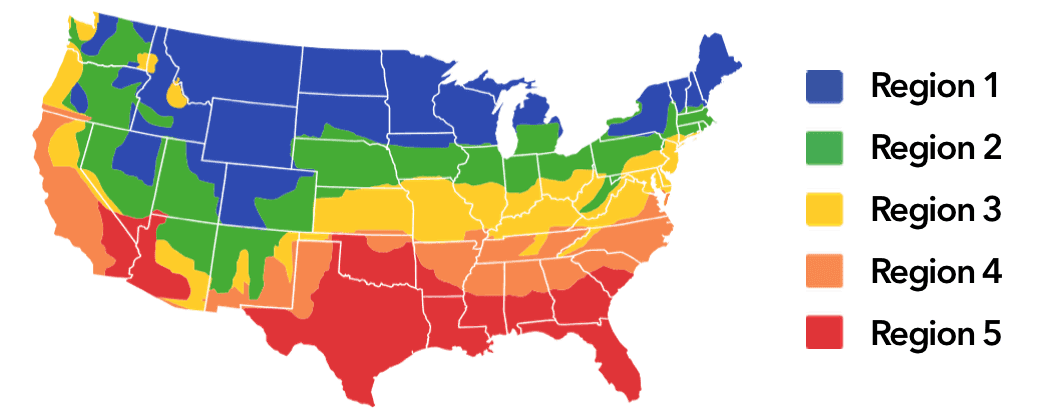
Then read across the chart: your zone on one side, your square footage on the other, and the suggested tonnage where they meet.
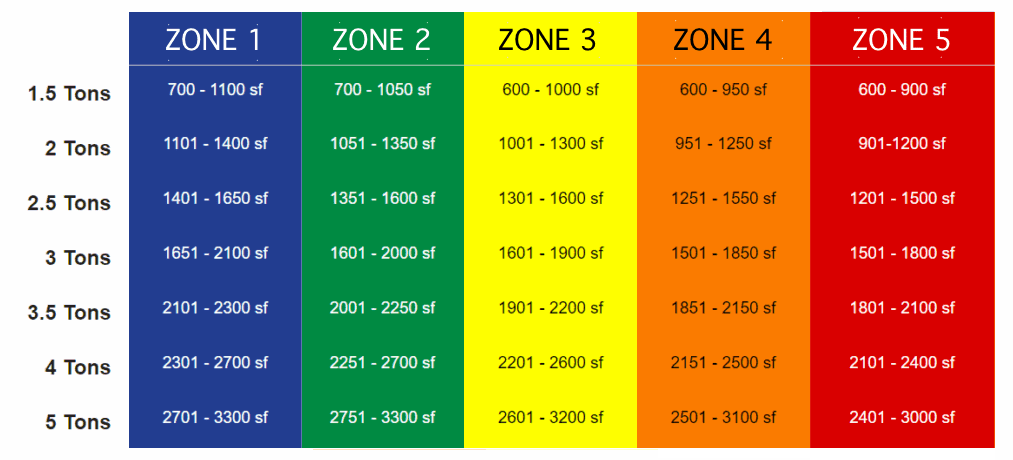
Treat it as a starting point. The chart knows your zone and your square footage and nothing about your windows, your insulation or that west-facing bonus room that bakes every afternoon.
Two DIY Ways to Estimate AC Tonnage
Neither replaces a real load calculation, but both get you close enough to spot a contractor quote that’s way off.
Method 1: The 500-600 Square Foot Rule
Take the square footage you cool and divide by 600 if the house is tight and well insulated, or by 500 if it’s average or drafty. Round up to the next half ton.
Say you have 1,950 square feet. A newer, well-sealed house divides out to 3.25, so 3.5 tons. A 1970s ranch with original windows comes to 3.9, so 4 tons.
Method 2: The 25 BTU Formula
This one builds in a climate adjustment:
(Square feet × 25 ÷ 12,000) − 0.5 = tons
Take 1,900 square feet. Multiply by 25 and you get 47,500 BTUs. Divide by 12,000 and that’s 3.96. Knock off half a ton and you’re at about 3.5 tons.
Live somewhere brutally hot for most of the year? Flip the minus to a plus. The same house now comes out near 4.5 tons on paper (in practice a 4- or 5-ton unit, which is when you want a real load calc), because a unit sized for mild weather will run nonstop and still fall behind in July.
Keep a lid on it: don’t go more than about 15% above the BTUs you calculated. If the math says 24,000 BTUs, your ceiling is roughly 27,600, so a 2-ton unit is right. A 2.5-ton (30,000 BTUs) already blows past that cap, and 3 tons is way off.
Central AC Cost by Size
A 2.5-ton system dropped into a house with working ductwork runs about $8,450-$11,630 installed.
Ducts are where budgets blow up. New or reworked ductwork adds roughly $2,640-$6,540, depending on how many walls and ceilings have to be opened. If a finished house has no ducts at all, expect the total to climb to $13,210-$18,170 or more.
Equipment-only prices by tonnage (installation not included):
| Unit size | Cooling output | Covers about | Unit price (13-16 SEER) |
|---|---|---|---|
| 1 ton | 12,000 BTU/hr | 400-600 sq ft | $3,320 – $3,980 |
| 2 tons | 24,000 BTU/hr | 800-1,250 sq ft | $3,520 – $4,550 |
| 3 tons | 36,000 BTU/hr | 1,250-1,750 sq ft | $4,170 – $5,330 |
| 4 tons | 48,000 BTU/hr | 1,750-2,300 sq ft | $4,800 – $6,210 |
| 5 tons | 60,000 BTU/hr | 2,300-3,000 sq ft | $5,240 – $6,640 |
Each extra ton adds roughly $200-$890 to the equipment cost, and 18+ SEER boxes run more like $7,260-$10,600. Most homes never need a 5-ton unit. The 1-ton models are almost never worth installing as central air; if that’s all the cooling you need, a ductless mini-split will do the job better and usually for less.
Efficiency is the other big price lever. On a typical 1,800 sq ft house, going from 14 SEER to 18+ adds roughly $7,880-$10,840 to the estimate, and the payback can take years. At that level you’re buying a heat pump, which cools exactly like an AC and heats the house in winter too. The heat pump cost calculator breaks out those prices.
Brand matters less than the warranty and the installer. Carrier, Bryant, Daikin, York, Goodman, Amana, Heil, Maytag, Day and Night, American Standard and Mitsubishi all build solid equipment. Ask your contractor which two brands they service most; they’ll know which ones come back with problems.
Manual J: The Sizing Number You Should Insist On
Two houses with identical floor plans can need different equipment. The industry’s standard load calculation, Manual J, sorts that out by running these factors through software:
- People. Every person in the house adds roughly 250 BTUs of heat per hour.
- Windows and sun. How many, how old, and which way they face. Big south- and west-facing glass is a heat magnet, while mature trees on the sunny side take real load off the system.
- Insulation. The attic and roof matter most. If yours is thin, topping it up before you replace the AC may let you buy a smaller unit.
- The building itself: skylights, ceiling height, sun-baked exterior walls and heat coming through slab floors.
- Ductwork: what kind it is and whether it runs through a hot attic.
- Appliances that throw off heat, like a big range, a dryer or a home office full of electronics.
Any decent HVAC company runs one as part of a free quote. A whole-house Manual J is fine when you’re only swapping the AC and keeping the ducts. A room-by-room version is more precise, and it’s what you want when the ductwork is being replaced too, because each supply run gets sized from it.
Watch for these red flags:
- The eyeball estimate. A guy walks through for ten minutes and announces “you need 4 tons.” Nobody can do that accurately in their head.
- “Just match what you’ve got.” Your old unit may have been the wrong size from day one, and you’ve probably added insulation or new windows since then.
- Skipping the paperwork. If they won’t put in the effort to size it, ask yourself how much care they’ll put into the install.
And don’t push the air from a high-efficiency condenser through leaky old ductwork. You’ll lose a big chunk of what you paid for. Have the installer inspect the ducts, and price out repairs with our ductwork cost calculator. To run a detailed load yourself first, try the HVAC load calculator.
Oversized vs. Undersized AC: Why Both Cost You
Plenty of homeowners figure an extra half ton is cheap insurance. The contractor says 2.5 tons, so they ask for 3 “just in case.” That made some sense back when units were power hogs built to blast the house cold. Today’s systems are designed for long, steady cycles, and they only work right when they’re matched to the house.
Too big
- You pay hundreds more up front for capacity you’ll never use.
- It short-cycles: hits the thermostat setting fast, shuts off, starts again. That’s hard on the compressor.
- It doesn’t run long enough to pull moisture out, so the house feels cold and clammy. In humid climates that’s the biggest complaint.
- Rooms cool unevenly, and your bills go up anyway.
Too small
It runs nonstop on hot days and still can’t hold the temperature. All that runtime shows up on your electric bill and wears the unit out sooner.
Sizing gets the attention, but a sloppy install ruins more systems than a wrong tonnage does. A big share of early HVAC failures trace back to poor installation. If you’re paying for a premium brand, don’t hire the cheapest crew to save a few hundred bucks.
When a Mini Split Beats Central Air
Central air makes sense when you’re cooling a whole house and already have ducts. For one room, an addition or a converted garage, it’s usually the wrong tool.
Ductless mini splits cool (and heat) right where the indoor head hangs, so no air is lost in duct runs. A typical central system sits around 16 SEER. An average mini split is closer to 22, and premium single-zone models hit 33-40 SEER. Multi-zone setups top out around 24.
A handy homeowner can install one, which can save a few thousand dollars in labor. The trade-off is looks: you’ll see a wall unit in every room it serves.
AC Sizing FAQ
What size AC do I need for a 2,000 sq ft house?
Usually 3.5 to 4 tons. Lean toward 3.5 for a tight house in a mild climate, and 4 for an older, leaky house or anywhere in the Deep South.
How many square feet does a 3-ton unit cool?
Roughly 1,250 to 1,750 square feet. The top of that range assumes a tight, well-insulated house in a cooler climate; in hot, humid zones, figure toward the bottom.
What if my house needs more than 5 tons?
Residential units cap out at 5 tons, so larger homes get two separate systems, often one per floor or zone.
Got your tonnage? Plug it into the central AC cost estimator for a full installed price, or double-check the load with the BTU calculator. When you’re ready for real numbers, get free quotes from local HVAC installers and ask each one for a Manual J with their bid.
 See costs in your area
Start Here - Enter Your Zip Code