Furnace Replacement Cost Calculator: 2027 Prices & BTU Size
A new 95% AFUE gas furnace costs about $7,480 to $9,230 installed in an average-size home, and the most common way to overpay is buying more furnace than the house needs. This calculator sizes the furnace in BTUs from your home and climate, then prices the install for your region: 80%, 95% and 97% AFUE gas units, plus 85% oil.
Gas Furnace Cost & Size in Columbus, OH
- Estimated Load
- Heating: 0 BTU
- Recommended Equipment
- Heating: 0 BTU Furnace
See costs in your area Start Here - Enter Your Zip Code
How to Use the Furnace Calculator
The main fields cover most jobs. “Show More Options” adds ceiling height, insulation, air tightness, windows and sun exposure, which matter if your house is unusually tight, leaky, sunny or tall-ceilinged.
- Home size. Heated square footage only. Leave out the garage and the crawlspace.
- Furnace efficiency. 95% AFUE is the default because it’s what most people install now. If you can’t run new PVC vent pipe, switch to 80%.
- Fuel type. Gas or oil. Pick oil and efficiency switches to 85% AFUE, since that’s what oil furnaces come in. Propane units cost about the same to install as gas, so price propane with the gas setting.
- Project type. Swapping out a working system is “Replace Old System.” New construction and gut renovations usually need ducts too, and picking new construction switches the duct field for you.
- Air ducts. “Need to Install Ducts” adds new insulated duct (R-8) to the price and asks how many floors the house has.
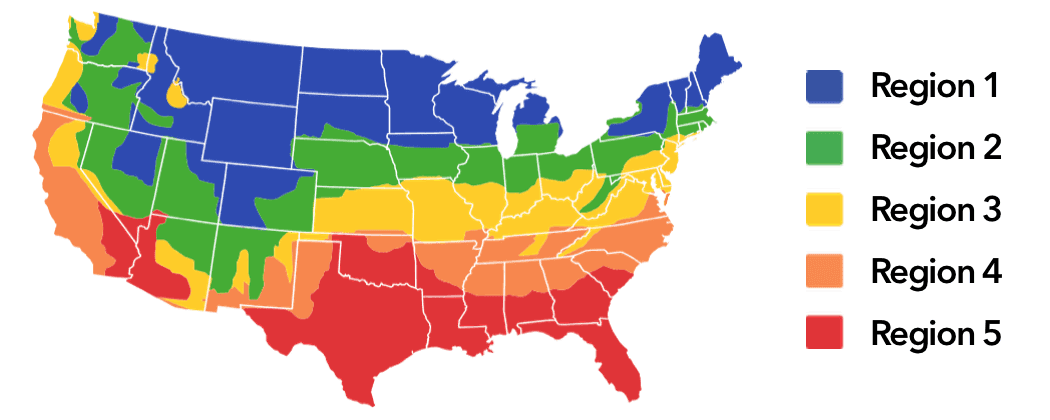
- Climate region. It’s filled in from your location. Check it against the zone map under the calculator, because colder regions need more BTUs per square foot.
Hit Calculate and you get the heat load, the recommended furnace size and three installed prices: low end, mid range and high end. Most people pay near the middle figure. An experienced tech who just opened his own shop will often quote near the low end and still do great work.
Quick Answers
Answers use Ohio averages; energy prices updated October 2026.
Is a heat pump cheaper to run than natural gas in Ohio?
Not in Ohio right now. Natural gas buys 63,517 BTUs per dollar; a heat pump at a COP of 3 buys 43,990. Power would have to drop below about 16.1¢ per kWh to flip that (the Ohio average is 23.3¢), or the heat pump would need a higher COP.
How does electricity in Ohio compare with the national average?
Ohio averages 23.3¢ per kWh, 7% above the U.S. average of 21.7¢ and the 16th highest of the 50 states and DC. AC and heat pump running costs rise and fall with that rate.
Do I need a cold-climate heat pump in Ohio?
It’s a smart upgrade. With a statewide average winter low around 20°F, a standard heat pump handles most nights in Ohio, but cold snaps cut its output. A cold-climate model or a backup heat source covers those.
How much does a heat pump save over baseboard heat in Ohio?
At a COP of 3, about two-thirds. At the Ohio average of 23.3¢ per kWh, baseboard heat costs about $68.20 per million BTU; a heat pump delivers the same heat for about $22.73.
When is the best time to replace HVAC in Ohio?
Spring or fall, before you need it. Installers are busiest in the first heat wave and the first cold snap, and an emergency swap leaves no time to compare quotes.
Should I replace the furnace and AC at the same time?
If both are well into their life, usually yes: one crew visit, one labor bill, and a matched indoor coil and outdoor unit, which is what the efficiency rating assumes. If one of them is fairly new, price the jobs separately.
Run your own numbers: Central AC cost estimator or Heat pump cost calculator.
Heating Costs in Ohio
Typical installed prices for heating systems in Ohio.
What a New Gas Furnace Costs
For a 2,000 sq. ft. house with average insulation, a 100,000 BTU, 95% AFUE gas furnace runs $7,480 to $9,230 installed at typical rates, and most homeowners land near $8,400. Northeast and West Coast labor can push the top end toward $9,910 to $10,900.
That covers the unit, venting, labor and the contractor’s margin. New or upsized ductwork is priced separately.
Where the money goes
- Equipment: about $3,560 to $4,410. Furnace, vent pipe, drain fittings and small parts.
- Labor: about $3,310 to $4,070. Setting the unit, venting, hookups and startup.
- Tear-out and setup: about $600 to $770. Pulling and hauling away the old furnace.
Overhead and profit are already in those numbers: trucks, office, warranty callbacks. Don’t begrudge it. A contractor who isn’t making money won’t be around when your igniter fails in year three.
Adding a heat pump for a “dual fuel” setup stacks its cost on top of the furnace, so the total usually starts around $13,360. The heat pump cost calculator prices that half of the job.
Gas, Oil or Propane: What It Costs to Run
The install is a one-time bill. Fuel comes due every winter. Here’s roughly what a 1,900 sq. ft. Massachusetts home burns in a season (95% gas or propane furnace, 85% oil furnace):
| Fuel | Fuel used per season | Typical cost vs. gas |
|---|---|---|
| Natural gas | About 1,160 therms | Baseline |
| Heating oil | About 930 gallons | Often a third more |
| Propane | About 1,270 gallons | Often double or more |
Fuel prices move by month and by state. For dollar figures where you live, run your system through the home heating cost calculator.
80% vs. 95% AFUE: Is High Efficiency Worth It?
AFUE is the share of fuel that ends up as heat in your house. An 80% furnace sends a fifth of every fuel dollar up the flue, while a condensing 95-97% unit loses only 3-5%. Replacing a tired 76% furnace with a 95-97% model can cut fuel use by roughly 20%.
Check two things before you sign:
- Rebates. Many utilities and state energy programs pay cash back on 95%+ AFUE furnaces with variable-speed (ECM) blowers. Amounts vary a lot by state and utility, so look them up before you pick a model. Good installers handle the paperwork.
- Your ducts. ECM blowers move more air. Undersized ducts choke them, and the efficiency you paid for quietly disappears. Ask the installer to measure static pressure.
Fix the Leaks Before You Buy Extra BTUs
A 98% furnace won’t save much if the heat escapes before it reaches the rooms. In most older homes the bigger losses are elsewhere:
- Uninsulated ducts can waste 25-30% of your heat, especially runs through an attic or crawlspace. On a $400 winter heating bill, that’s $100 or more a month warming dead space. Price the fix with the ductwork cost calculator.
- The attic comes next. Bringing it up to spec can cut total heat loss 10-15%. See the attic insulation cost calculator.
- Empty wall cavities filled with blown-in or spray foam insulation can knock off another 7-10%.
- Triple-pane windows help too, but only about 5-7%, which makes them the slowest payback of the four.
Tighten the house first and you may drop a furnace size, which saves money on the install and every winter after.
How the Calculator Sizes Your Furnace
It starts with BTUs per square foot for your climate region, then adds two losses that quick sizing charts skip:
- Duct loss: a flat 8.5%. Leaky, uninsulated runs can lose 15% or more.
- Venting loss: about 20% for an 80% unit versus 3-5% for a condensing model, which is why an 80% furnace often comes out a size bigger.
Residential furnaces top out around 125,000 BTU, so homes over about 3,000 sq. ft. may need two. The calculator stacks 125K units and covers the remainder with a 40K, 60K, 80K, 100K, 110K or 120K unit. A 160K load gets priced as 125K plus 40K, though two 80K units would come in a little lower.
Treat the size as a starting point. The final equipment call belongs to you and your installer, ideally backed by a room-by-room HVAC load calculation. For a second opinion on size alone, the furnace size calculator runs the BTU math by itself. If you heat with hot water instead of air, use the boiler cost calculator.
Furnace Sizing and Venting Questions
What size furnace does a 2,000 sq. ft. house need?
With average insulation in a cold climate, about 100,000 to 110,000 BTU. Tighter houses and milder regions need less, so run your own numbers.
Can I vent a high-efficiency furnace into my old chimney?
No. Condensing furnaces make cool, wet exhaust that has to leave through sealed PVC pipe, usually out a side wall. If that isn’t practical, an 80% unit is the fallback.
When you compare quotes from local furnace installers, ask each one to write the model, BTU size and AFUE on the bid. If one price is far below the rest, check whether it includes the venting, the condensate drain and the permit.
 See costs in your area
Start Here - Enter Your Zip Code