HVAC Load Calculator 2027: Heating & Cooling BTUs + Cost
This HVAC load calculator turns your climate, square footage and a few facts about the house into the BTUs you need to heat and cool it, the system type that fits, and a ballpark install price. Check it against any contractor’s quote before you sign.
Heat Load (BTUs), HVAC Size & Cost in Columbus, OH
- Estimated Load
- Cooling: 0 BTUs
- Recommended Equipment
- 0 Ton Central AC
See costs in your area Start Here - Enter Your Zip Code
How to Use the HVAC Load Calculator
The first five fields do most of the work. The rest sit under Show More Options. The result gets close to a Manual J figure, but only if the inputs are honest.
- Area size: the whole house, or just the part you’re conditioning, like an addition or a finished basement. Measure it; don’t trust the listing sheet.
- System type: cooling only, heating only, or both. Pick both if you want one recommendation for the whole year.
- Ducts: say whether the house already has ductwork. It decides which systems the calculator suggests.
- Insulation grade: a house framed with 2×4 walls between the late ’70s and about 2000 typically has R-13 in the walls and should have around R-38 overhead. That’s “average.” Newer 2×6 construction with roughly R-18 walls earns “more than average.” Save “very well insulated” for a true super-insulated build, and pick “less than average” or “poorly insulated” if parts of the house were never insulated. Stuck between two grades and shopping mainly for AC? Take the better one, since every step down adds BTUs to the cooling side too.
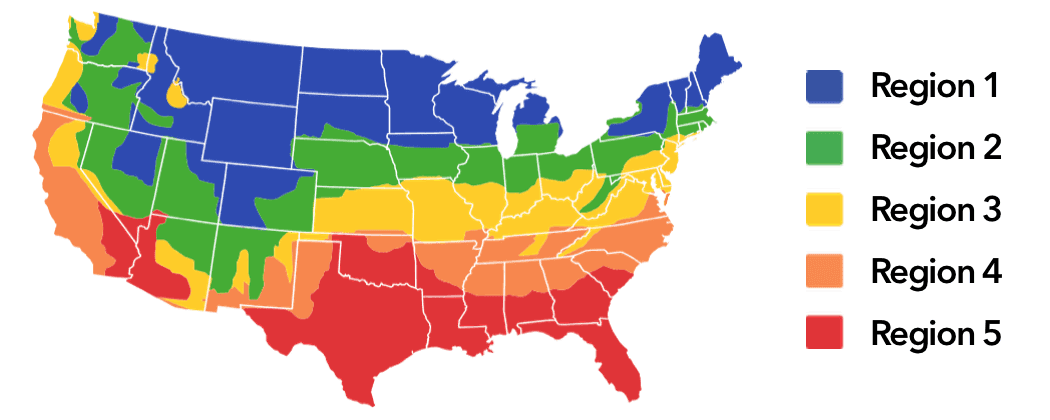
- Climate region: filled in from your location. Check it against the color map under the calculator. New York City and most of New Jersey fall in Region 3 (yellow); Texas is Region 5 (red). No other setting moves the answer as much: switch from Region 1 to Region 5 and the heating and cooling loads swing hard in opposite directions.
- Rooms (zones): barely matters for a ducted setup (central air with a warm-air furnace) or a boiler. With ductless, the zone count decides between one multi-zone outdoor unit and several single-zone systems, and that changes the price of a mini-split install quite a bit.
- Space height: most houses have 8-foot ceilings. For a sloped ceiling, average the low wall and the peak: an 8 ft wall rising to a 13 ft peak works out to 10.5 ft, since (8 + 13) / 2 = 10.5.
- Sun exposure: “strong” if the house bakes in full sun most of the day, “shaded” if trees or neighboring buildings block it.
- Windows: walk the outside walls. Roughly one window per 8 feet of wall is “average.” Noticeably more glass than that, pick “more than average.”
- Air tightness: unless you can feel drafts around the frames, leave it on “average.”
Quick Answers
Answers use Ohio averages; energy prices updated October 2026.
Is a heat pump cheaper to run than natural gas in Ohio?
Not in Ohio right now. Natural gas buys 63,517 BTUs per dollar; a heat pump at a COP of 3 buys 43,990. Power would have to drop below about 16.1¢ per kWh to flip that (the Ohio average is 23.3¢), or the heat pump would need a higher COP.
How does electricity in Ohio compare with the national average?
Ohio averages 23.3¢ per kWh, 7% above the U.S. average of 21.7¢ and the 16th highest of the 50 states and DC. AC and heat pump running costs rise and fall with that rate.
Do I need a cold-climate heat pump in Ohio?
It’s a smart upgrade. With a statewide average winter low around 20°F, a standard heat pump handles most nights in Ohio, but cold snaps cut its output. A cold-climate model or a backup heat source covers those.
How much does a heat pump save over baseboard heat in Ohio?
At a COP of 3, about two-thirds. At the Ohio average of 23.3¢ per kWh, baseboard heat costs about $68.20 per million BTU; a heat pump delivers the same heat for about $22.73.
When is the best time to replace HVAC in Ohio?
Spring or fall, before you need it. Installers are busiest in the first heat wave and the first cold snap, and an emergency swap leaves no time to compare quotes.
Should I replace the furnace and AC at the same time?
If both are well into their life, usually yes: one crew visit, one labor bill, and a matched indoor coil and outdoor unit, which is what the efficiency rating assumes. If one of them is fairly new, price the jobs separately.
Run your own numbers: Central AC cost estimator or Heat pump cost calculator.
HVAC Costs in Ohio
Typical installed prices in Ohio, equipment and labor.
What Your BTU and Tonnage Results Mean
You get two outputs.
The load. Heating and cooling are shown separately, in BTUs per hour and in tons (one ton equals 12,000 BTU/h). To double-check the AC side, our AC tonnage calculator works it from a different angle.
A recommended system type, based on your region and inputs. It’s a starting point, not a verdict. In a new build you can choose anything. In an existing house, what’s already in the walls (or isn’t) narrows the options fast.
Expect both loads to come in roughly 20-30% below a contractor’s rule-of-thumb figure. That’s on purpose. Quick estimates are padded, and padding costs you money twice.
Why a Bigger HVAC Unit Is Usually the Wrong Call
An undersized system can’t keep up on the hottest or coldest days. An oversized one is the sneakier problem: you pay more for the equipment on day one, then keep paying through higher gas, oil or electric bills for the next 15 years. An oversized AC also short-cycles, cooling the air fast without pulling much humidity out of it, so the house feels clammy.
Installers go big anyway because a proper Manual J load calculation takes time, and a room-by-room version takes longer still. Going up a size is cheap insurance against callbacks, and you’re the one paying for it. Supplier sizing charts are padded for the same reason.
Which System Fits the House You Already Have?
You have ductwork. Central air paired with a gas furnace is almost always the cheapest way to go. In hot southern climates, an electric heat strip in the air handler can stand in for the furnace on the handful of chilly nights you get.
No ducts, cold climate (Regions 1-3). A hot-water boiler feeding baseboards, radiators or radiant floors is the best heat. For cooling, a multi-zone ductless system is efficient and cheap to run.
No ducts, milder climate (Regions 3-5). Winters here rarely drop below 0°F on average. A high-efficiency ductless heat pump can handle both heating and cooling, and it’s the cheapest option to run. Cold-climate models keep heating down to about -15°F on roughly a third to a quarter of the electricity a plug-in space heater would use. Skipping a separate furnace or boiler can save you roughly $6,600 to $18,150+ in install costs.
In Regions 1 and 2, don’t make a heat pump your only heat source if long winter outages are common where you live. It needs power. Keep a backup that can carry you a few days, like an old boiler or a gas or pellet stove, and the heat pump can still be your main system.
Zoning is where ductless really pays. Spending the afternoon in the den? Run that one head, then switch to the bedrooms at night. Add the efficiency edge a good inverter mini-split has over most central AC, and running costs often drop 40% or more. That counts most where power is pricey: much of the South pays somewhere around 13-17 cents per kWh, parts of California run past 40 cents, and peak-hour rates go higher still.
Pro Tip: Single-story ranch or cape with no ducts? The air handler and insulated flex duct can often go in the attic. That costs far less than running sheet-metal trunk lines up from a basement through finished walls, and it makes central air noticeably cheaper up front than ductless. Ductless still tends to run around 40% cheaper to operate, so the gap closes over time. Price both, and use our ductwork cost calculator for the duct side.
Shrink the Load Before You Size the Equipment
The cheapest BTU is the one you never need. Topping up the attic, insulating walls where you can, and sealing and wrapping leaky ducts can trim heating and cooling costs by 15-25%. It can also drop you a full equipment size, which saves money at purchase too.
Price the upgrade with our attic insulation cost calculator, then rerun the load calculator above with the better insulation grade before you settle on a size.
Large Homes: Splitting the Load Across Several Systems
Residential central AC tops out at 5 tons (60,000 BTU/h). Bigger houses, usually anything past about 3,000 sq ft, need more than one system.
Say your load comes back at 150,000 BTU/h. The calculator fills that with two full-size 5-ton units and covers the leftover 30,000 BTU/h with a 2.5-ton system, instead of three big ones. Biggest units first, then the smallest one that closes the gap, keeps the estimate as low as it honestly can be.
The installed price is built from equipment cost plus national-average labor, overhead and profit for that system type. Local rates will move it up or down.
HVAC Load Questions Homeowners Ask
How accurate is an online HVAC load calculator?
Good enough to budget and to spot a padded quote. It’s not a substitute for a full Manual J, which looks at orientation, window specs and each room individually. Treat our number as the honest middle and verify before you buy.
Should I get a Manual J before buying a new system?
Yes, especially on a whole-house replacement. Ask every contractor whether they ran one. If they sized the unit by square footage alone, or just matched the old unit’s label, that’s a red flag.
My contractor quoted a bigger system than this. Who’s right?
Ask to see their math. A quote 20-30% above our result is typical of rule-of-thumb sizing. If they can show a real load calculation, trust it. If not, get a second opinion.
For a second angle, the furnace size calculator checks the heating side, the central air cost calculator prices the cooling side, and the heat pump calculator prices a single system that does both. Ready to compare real bids? Get free quotes from local HVAC pros and bring your load numbers along.
This calculator is for planning and information only. Confirm sizing with a full load calculation before you buy equipment.
 See costs in your area
Start Here - Enter Your Zip Code