Solar Panel Angle Calculator: Best Tilt by Zip Code (2027)
Enter your zip code and this calculator finds the tilt that gets the most yearly power from a south-facing solar array at your address, along with your latitude, seasonal angles for adjustable racks, and the matching roof pitch. In the lower 48, the best angle runs from about 23 degrees in South Florida to about 35 near the Canadian border.
Calculate Best Solar Angle & Roof Pitch
Estimated Generation & Losses of a 10 KW Solar PV System in Ohio, based on Deviation from Ideal Angle
| Deviation (°) | 10 KW Production | Loss (kWh) | Loss (%) |
|---|---|---|---|
| 5° | 15,101 kWh | 46 kWh | 0.31% |
| 10° | 14,932 kWh | 215 kWh | 1.42% |
| 15° | 14,668 kWh | 480 kWh | 3.17% |
| 20° | 14,274 kWh | 873 kWh | 5.76% |
| 25° | 13,772 kWh | 1,375 kWh | 9.08% |
| 30° | 13,147 kWh | 2,000 kWh | 13.21% |
| 35° | 12,475 kWh | 2,672 kWh | 17.64% |
| 40° | 11,736 kWh | 3,411 kWh | 22.52% |
| 45° | 10,544 kWh | 4,603 kWh | 30.39% |
Say the best angle for your roof is 30°, but the panels sit flat. That’s a 30° miss, and it costs you about 13.21% of what the panels could make, just because they don’t face the sun squarely.
Here’s what that means in kWh. A 10kW solar PV system in OH, could make about 15,148 kWhs a year in a perfect setup with no other losses.
Tilted 30° off the ideal, the same system makes 15,146 kWhs. You lose 2,001 kWhs of production every year.
Los Angeles, CA latitude is 34.0549°
Best Solar Panels Angle: 28.76°
Ideal Roof Pitch for Solar: 7/12
Sun Hours / Day: 5.38
10 kW Solar Production: 16,888 - 17,673 kWh
California averages 5.38 hour of sunlight per day. A 10 KW solar PV system in Los Angeles should make around 17,281 kWhs a year.
Electricity in CA averages $0.3773/kWh. Use ALL of that solar power yourself and you’d save roughly $6,670/year!
Best Use of Solar Electricity in CA:
Gasoline in CA costs around $7.03917. Next to that, charging a Tesla (or any EV) off your own panels is dirt cheap!
A Heat Pump is the other big win. Run it on solar and you’d save about $1,960 a year on cooling and $700 on heating!
LA Ideal Solar Panels Angle by Month:
| Month | Angle | Pitch |
|---|---|---|
| January | 38.8° | 10/12 |
| February | 33.8° | 8/12 |
| March | 28.8° | 7/12 |
| April | 23.8° | 5/12 |
| May | 18.8° | 4/12 |
| June | 13.8° | 3/12 |
| July | 18.8° | 4/12 |
| August | 23.8° | 5/12 |
| September | 28.8° | 7/12 |
| October | 33.8° | 8/12 |
| November | 38.8° | 10/12 |
| December | 43.8° | 12/12 |
New York, NY latitude is 40.7128°
Best Solar Panels Angle: 31.84°
Ideal Roof Pitch for Solar: 7/12
Sun Hours / Day: 3.79
10 kW Solar Production: 11,897 - 12,450 kWh
New York averages 3.79 hour of sunlight per day. A 10 KW solar PV system in New York should make around 12,173 kWhs a year.
Electricity in NY averages $0.3923/kWh. Use ALL of that solar power yourself and you’d save roughly $4,890/year!
Best Use of Solar Electricity in NY:
Gasoline in NY costs around $5.4201. Next to that, charging a Tesla (or any EV) off your own panels is dirt cheap!
A Heat Pump is the other big win. Run it on solar and you’d save about $1,170 a year on cooling and $3,710 on heating!
New York Ideal Solar Panels Angle by Month:
| Month | Angle | Pitch |
|---|---|---|
| January | 41.8° | 11/12 |
| February | 36.8° | 9/12 |
| March | 31.8° | 7/12 |
| April | 26.8° | 6/12 |
| May | 21.8° | 5/12 |
| June | 16.8° | 4/12 |
| July | 21.8° | 5/12 |
| August | 26.8° | 6/12 |
| September | 31.8° | 7/12 |
| October | 36.8° | 9/12 |
| November | 41.8° | 11/12 |
| December | 46.8° | 13/12 |
How to Use the Solar Panel Angle Calculator
Type a 5-digit zip code and tap Calculate. You get four numbers:
- Ideal Solar Panels Angle. The one fixed tilt, measured up from flat, that produces the most over a full year. Use it for flush-mounted panels and fixed racks.
- Your Latitude. Handy for checking an installer’s math, since many still go by the old tilt-equals-latitude rule (it runs a bit steep, see below).
- Ideal Summer / Winter Angle. For racks you can adjust by hand: about 15 degrees flatter in summer and 15 steeper in winter. An easy routine is to switch to the summer setting in late March and back in late September.
- Ideal Roof Pitch. The same angle in roofer terms, rise per 12 inches of run. Across the lower 48 it lands between roughly 5/12 and 8/12.
Under the calculator, a table shows what a 10 kW system should make in a year in your state and how much it gives up for every 5 degrees off the ideal. Worked examples for Los Angeles and New York follow, each with a month-by-month angle chart.
All of these numbers assume the panels face true south. A southeast or southwest slope still does well. A north slope is a different story (more on that below).
Why the Best Angle Is Flatter Than Your Latitude
The old rule of thumb says tilt equals latitude. Close, but a little steep.

The sun rides low in winter and high in summer. Panels set at full latitude favor the low sun of fall, winter and spring, but winter days are short and often cloudy, so the extra steepness doesn’t buy much. Lay the panels down a bit and they catch more of the long summer days, when most of the year’s power gets made.
So the year-round winner comes in flatter than your latitude, and the gap grows the farther north you live: a degree or two in South Florida, about 5 in Los Angeles, and roughly 9 to 13 across the northern states.
How Much Production a Bad Angle Costs
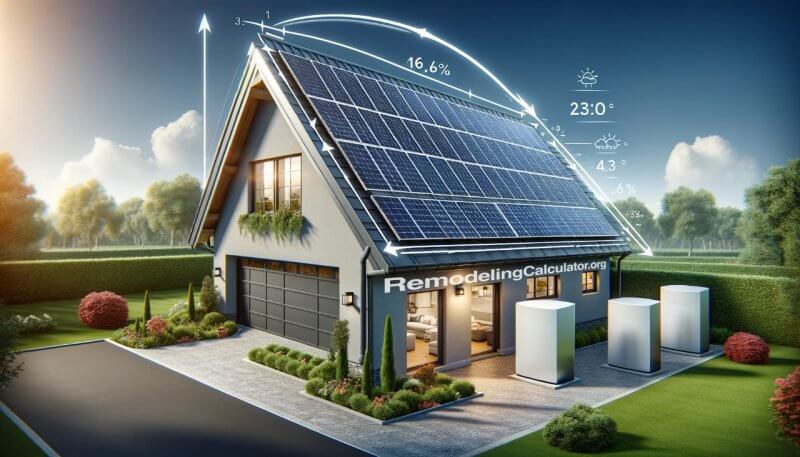
Being a little off barely matters. Within about 15 degrees of the best angle you give up around 3% or less, which rarely justifies paying for tilt-up racking on a pitched roof.
Past that, losses pick up speed, and each extra 5 degrees costs more than the last: about 13% at 30 degrees off and over 20% at 40. The table under the calculator puts those losses in kWh for your state.
Skip the North-Facing Roof
To hit a bigger system size, an installer may suggest covering the north side of your roof too. More kilowatts looks good on the contract.
It rarely pays. North-facing panels make so much less that your real cost per watt of output can climb toward double what you pay on the south slope. If the south and west sides are full, a smaller system is usually the better buy. And if the roof is due for replacement soon, price that job with our roof cost calculator before the panels go up. Pulling and resetting an array later is an expense you don’t want.
Common Solar Angle Questions
Does my roof pitch need to match the ideal angle exactly?
No. If your south-facing roof is within about 15 degrees of the calculator’s number, flush-mounted panels will do fine, and most standard U.S. pitches fall in that window.
What about a flat roof?
Flat roofs need tilt racks, so you can set the frames at the ideal angle instead of guessing. Wind load and row shading often push installers lower than that, and coming in 10 to 15 degrees flat costs only a few percent. If the membrane is old, check our flat roofing calculator first and replace it before the racks go down.
What should I run on all that solar power?
Heating and cooling are the big loads, so a heat pump pairs well with a good array. Our ductless heat pump energy cost calculator shows what one would cost to run in your area.
Ready to price a properly angled system for your house? Get free quotes from local installers.