Home Heating Cost in Minnesota (2027): Natural Gas vs Oil vs Electric
Heating costs for your home size in Minnesota
This page answers one question for Minnesota: which fuel heats a house for the least money right now. The inputs are current state-average energy rates and a heating load for Climate Region #1; the method is the one inside our heating cost calculator, set to mid-efficiency equipment.
Heating a 2,020 sq. ft. home through a Minnesota winter runs from about $1,440 on natural gas, the cheapest fuel here, up to roughly $5,210 on electric baseboard heat, the priciest.
Minnesota Heating Fuel Costs for One Season
| Fuel & equipment | Price | Season use | Cost / season |
|---|---|---|---|
| Natural gasnatural gas boiler, 82 AFUE | $1.18per therm | 1,212therms | ~$1,440 |
| Electric heat pumpductless, ~2.9 COP | $0.184per kWh | 13,217kWh | ~$2,440 |
| Propanepropane boiler, 82 AFUE | $1.90per gal | 1,325gals | ~$2,520 |
| Heating oiloil boiler, 82 AFUE | $5.74per gal | 874gals | ~$5,020 |
| Electric baseboardresistance heat | $0.184per kWh | 28,256kWh | ~$5,210 |
Each row is one heating season for 2,020 sq. ft., rounded up to $10. Switch the insulation level to see how much the house itself moves the bill. Method: our heating cost calculator.
A Season of Heat, Fuel by Fuel
Same house, same winter, five fuels. Hover a bar for the use and the rate behind it.
Season = the modeled Minnesota heating load on standard mid-efficiency equipment; fuels ranked like the heating cost calculator (pellet and wood stoves are manual-load and stay unranked).
The Next 10 Winters, Fuel by Fuel
This chart carries the season costs forward 10 winters. Electricity follows its Minnesota track record, about 2.54% a year (2013 to 2023, energy database). Natural gas, heating oil and propane have no long series in our data, so they get two clear cases rather than an invented rate. Hover or tap a column for that winter's costs.
Winter 1 uses today's rates and later winters apply the trend, all at average insulation; every total is rounded up to the next $10.
With natural gas, oil and propane held at today's prices, 10 winters on natural gas add up to about $14,320, and on electric baseboard heat to about $58,380. Watch the crossing: the heat pump line climbs past propane in winter 3 in this case.
Minnesota Climate and Your Heating Load
Minnesota falls in Climate Region #1, the coldest band on the map below. Winter afternoons average about 19°F and nights drop to around 1°F, so a furnace or boiler here runs long cycles for months, and heat is the biggest energy cost of the year.
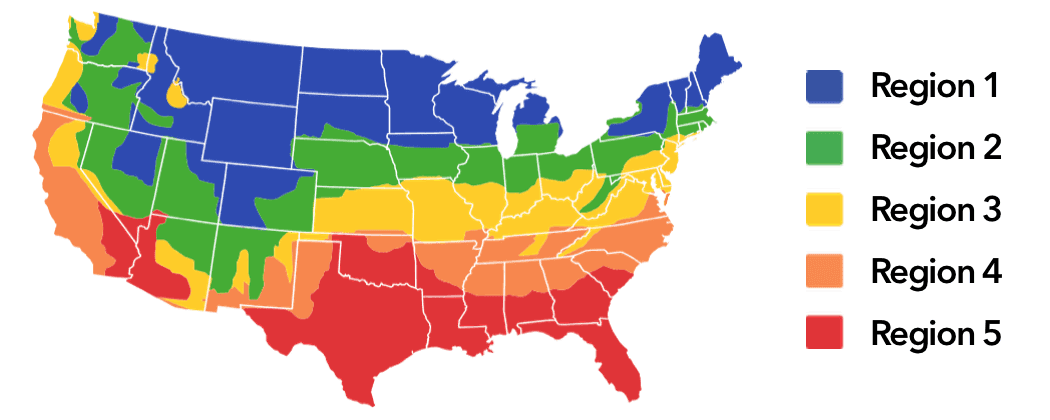
What the local weather means for heating equipment:
Snow cover. A heat pump's outdoor coil needs open air to work, and condensing furnaces breathe through low wall vents. Both need clearance from snowbanks, so ask the installer how high they mount the unit and the vents.
Roof ice. When warm house air escapes into the attic, snow on the roof melts and refreezes at the cold eaves. That ice is a visible heat-loss meter: air sealing and attic insulation fix both problems.
Windy cold. Wind raises the heating load by driving outside air through leaks. Weatherstripping and sealing the rim joist often pay back faster than any equipment upgrade.
Outside the towns, many Minnesota homes sit beyond the natural gas mains and heat with propane from a tank on site. That propane row, at $1.90 a gallon, is the realistic comparison for a rural house. The best window for new heating equipment here is the off-season, before the first hard freeze. A failure in January means paying for speed, not for the best quote.
Beyond Fuel: Where Heating Money Leaks
- The shell of the house. A well-insulated home needs about 12% less heat than an average one in this model, and a drafty one about 12% more; with natural gas in Minnesota, each step is worth about $180 a season.
- The ducts. A forced-air system with bare ducts loses roughly 17% of its output on the way to the rooms, according to the calculator's duct model. Ductless systems and radiators skip that loss.
- Burner efficiency. The table assumes a mid-efficiency boiler at 82 AFUE. A condensing unit at 93 AFUE burns less fuel for the same heat, about $170 a season less on natural gas here. An old 62 AFUE unit burns about $470 more.
Heat Pump vs. Electric Baseboard in Minnesota
If your home heats with baseboards, the heat-pump row is the upgrade path. In Minnesota the model credits a heat pump with about 2.2 kWh of heat per kWh, counting the efficiency a heat pump loses in hard cold, so the season drops from roughly $5,210 to $2,440, about $2,770 less every winter. That puts it in second place in Minnesota, after natural gas.
Common Questions About Heating a Minnesota Home
Does it pay to replace an oil boiler in Minnesota?
For most homes, yes. This house would spend about $5,020 a season on heating oil and about $1,440 on natural gas, so 10 winters at flat prices leave roughly $35,830 on the table. Weigh that against the conversion quote. That option needs natural gas service at the street.
Which heating fuel costs least in Minnesota?
At current rates the winner is natural gas, about $1,440 a season for this house; a heat pump follows at about $2,440. That assumes the home is on a natural gas main.
What is better insulation worth on a Minnesota heating bill?
With natural gas, a poorly insulated 2,020 sq. ft. home costs about $1,610 a season and a well-insulated one about $1,270. That $350 gap repeats every winter.
Pellet and wood stoves stay out of the ranking because they need hand loading; see the pellet stove calculator for their costs.
About these numbers: seasonal estimates from current average Minnesota energy rates and a modeled heating load. Use them to compare fuels, not as a quote; real bills follow your winter, your house and your equipment.