Home Heating Cost in Michigan (2027): Natural Gas vs Oil vs Electric
Heating costs for your home size in Michigan
How much heat does a Michigan home burn in a winter, and what does it cost on each fuel? We take today's average rates for natural gas, heating oil, propane and electricity, apply a Region #1 heating load for your home size, and price the result the way our heating cost calculator does.
Take a 1,720 sq. ft. Michigan home: natural gas is the low-cost fuel at about $1,250 a season, and electric baseboard heat sits at the other end near $6,640. Same house, same winter: a gap of about $5,390.
Michigan Heating Fuel Costs for One Season
| Fuel & equipment | Price | Season use | Cost / season |
|---|---|---|---|
| Natural gasnatural gas boiler, 82 AFUE | $1.21per therm | 1,032therms | ~$1,250 |
| Propanepropane boiler, 82 AFUE | $2.34per gal | 1,128gals | ~$2,640 |
| Electric heat pumpductless, ~2.9 COP | $0.276per kWh | 11,254kWh | ~$3,110 |
| Heating oiloil boiler, 82 AFUE | $5.58per gal | 744gals | ~$4,160 |
| Electric baseboardresistance heat | $0.276per kWh | 24,060kWh | ~$6,640 |
Rounded up to $10. Rates are current Michigan averages; the load is a 1,720 sq. ft. home at the insulation level you pick above. Same method as the heating cost calculator.
A Season of Heat, Fuel by Fuel
Same house, same winter, five fuels. Hover a bar for the use and the rate behind it.
Season = the modeled Michigan heating load on standard mid-efficiency equipment; fuels ranked like the heating cost calculator (pellet and wood stoves are manual-load and stay unranked).
10-Year Heating Cost Outlook for Michigan
A fuel that wins this winter can lose later if its price climbs faster. The electric lines below rise at Michigan's own electricity trend, about 2.44% a year from 2013 to 2023. For natural gas, heating oil and propane our data has no comparable history, so you choose: hold them at today's price, or let them climb at the electricity pace. Tap or hover any winter to read the numbers.
Winter 1 uses today's rates and later winters apply the trend, all at average insulation; every total is rounded up to the next $10.
With natural gas, oil and propane held at today's prices, 10 winters on natural gas add up to about $12,450, and on electric baseboard heat to about $74,100.
Michigan Climate and Your Heating Load
Michigan falls in Climate Region #1, the coldest band on the map below. Winter afternoons average about 28°F and nights drop to around 13°F, so a furnace or boiler here runs long cycles for months, and heat is the biggest energy cost of the year.
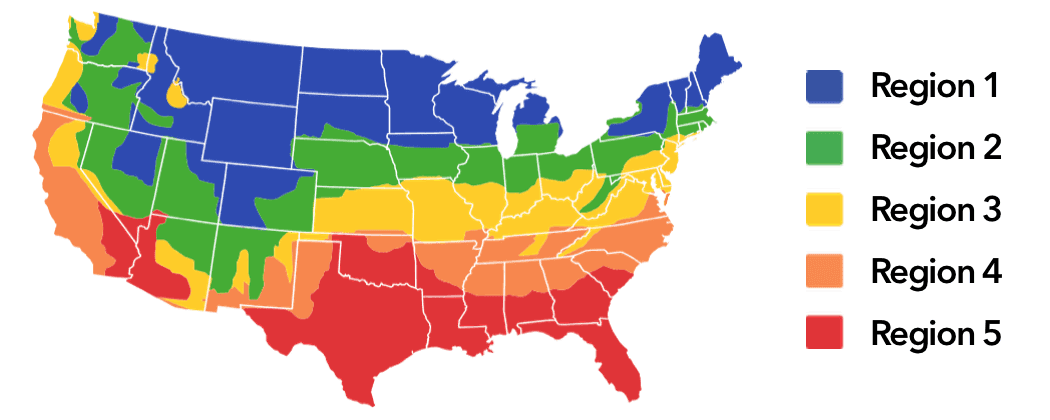
What the local weather means for heating equipment:
Deep snow. Snow can bury an outdoor heat-pump unit and block the plastic side-wall vents of a high-efficiency furnace. Set the outdoor unit on a stand above the usual drift line and keep vent openings clear; a blocked intake shuts a furnace down.
Roof ice. When warm house air escapes into the attic, snow on the roof melts and refreezes at the cold eaves. That ice is a visible heat-loss meter: air sealing and attic insulation fix both problems.
Hard freezes. If the heat fails during a deep freeze, water pipes can split within hours. Book the tune-up before the first cold snap, and consider a freeze alarm or a thermostat that sends alerts.
Great Lakes snow bands can drop a foot of snow on parts of Michigan in a day. After each storm, clear the heat pump's outdoor unit and the furnace vents so the system keeps running. Replace a furnace or boiler in late summer or early fall. Once the first deep freeze arrives, installers fill up with no-heat emergencies, and you lose bargaining power.
Beyond Fuel: Where Heating Money Leaks
The equipment. Our figures assume 82 AFUE. Swap in a 93 AFUE condensing boiler and the natural gas bill drops by about $150; keep running a tired 62 AFUE unit and it rises by about $410.
The shell of the house. A well-insulated home needs about 12% less heat than an average one in this model, and a drafty one about 12% more; with natural gas in Michigan, each step is worth about $150 a season.
Out of the ducts. Bare ducts in unheated space waste about 17% of a furnace's heat; sealed, insulated ducts keep most of it in the house.
Why the Heat Pump Beats Baseboard
Both electric rows use the same $0.276 per kWh rate. The difference is the machine: resistance heat converts power to heat one for one, while a heat pump gets about 2.2 units of heat per unit of power here, after a cold-climate deduction. The result is about $3,110 a season instead of $6,640. In Michigan it still trails natural gas and propane.
Michigan Heating: Quick Answers
What heats a Michigan house for the least money?
By today's rates, natural gas wins at about $1,250 a season, with propane next at about $2,640. That assumes the home is on a natural gas main.
How much does insulation change the heating bill here?
Quite a bit. On natural gas, the same 1,720 sq. ft. house runs about $1,400 a season when poorly insulated and about $1,100 when well insulated, a yearly difference of about $300.
Does it pay to replace an oil boiler in Michigan?
Today's numbers favor the switch: about $4,160 a season on heating oil against about $1,250 on natural gas. That is roughly $29,110 over 10 winters if prices hold, before any installation cost. The natural gas route works only where a natural gas line can reach the property.
Wood and pellet stoves are not ranked here because someone has to load them. The pellet stove calculator prices them on their own.
About these numbers: seasonal estimates from current average Michigan energy rates and a modeled heating load. Use them to compare fuels, not as a quote; real bills follow your winter, your house and your equipment.