Home Heating Cost in Indiana (2027): Natural Gas vs Oil vs Electric
Heating costs for your home size in Indiana
Every figure below starts from Indiana's current average energy prices and runs them through the seasonal model behind our heating cost calculator: a Climate Region #2 heating load sized to your home, served by standard mid-efficiency equipment.
The spread is wide: about $1,410 a winter with natural gas versus about $5,060 with electric baseboard heat, for one 2,010 sq. ft. home in Indiana. That $3,660 difference comes from the fuel alone.
What a Season of Heat Costs in Indiana, by Fuel
| Fuel & equipment | Price | Season use | Cost / season |
|---|---|---|---|
| Natural gasnatural gas boiler, 82 AFUE | $1.30per therm | 1,085therms | ~$1,410 |
| Electric heat pumpductless, ~2.9 COP | $0.200per kWh | 10,451kWh | ~$2,100 |
| Propanepropane boiler, 82 AFUE | $2.47per gal | 1,185gals | ~$2,930 |
| Heating oiloil boiler, 82 AFUE | $5.76per gal | 782gals | ~$4,510 |
| Electric baseboardresistance heat | $0.200per kWh | 25,283kWh | ~$5,060 |
Rounded up to $10. Rates are current Indiana averages; the load is a 2,010 sq. ft. home at the insulation level you pick above. Same method as the heating cost calculator.
A Season of Heat, Fuel by Fuel
Same house, same winter, five fuels. Hover a bar for the use and the rate behind it.
Season = the modeled Indiana heating load on standard mid-efficiency equipment; fuels ranked like the heating cost calculator (pellet and wood stoves are manual-load and stay unranked).
The Next 10 Winters, Fuel by Fuel
This chart carries the season costs forward 10 winters. Electricity follows its Indiana track record, about 3.24% a year (2013 to 2023, energy database). Natural gas, heating oil and propane have no long series in our data, so they get two clear cases rather than an invented rate. Hover or tap a column for that winter's costs.
Season costs at average insulation; winter 1 is today's prices. Totals rounded up to $10.
Fossil fuels flat, electricity on its trend: the cheapest 10-winter total is natural gas at about $14,060; the most expensive is electric baseboard heat at about $58,650.
Indiana Climate and Your Heating Load
Winter in Indiana averages about 36°F by day and 20°F by night, which puts it in Region #2 on the map below, one step down from the coldest band. Heating still dominates the energy budget here.
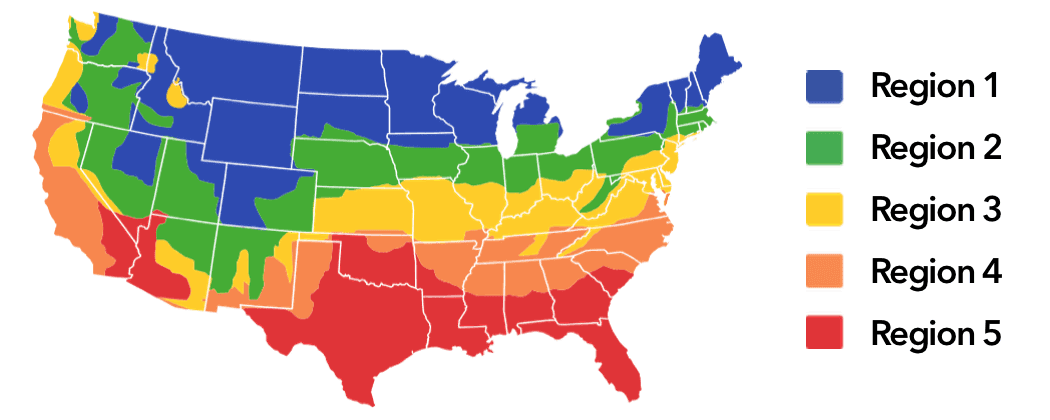
Climate details worth raising with an installer:
Cold-snap failures. A heating breakdown during a hard freeze can mean burst pipes by morning. A fall tune-up, spare filters and a temperature alert on the thermostat are cheap insurance.
Roof ice. When warm house air escapes into the attic, snow on the roof melts and refreezes at the cold eaves. That ice is a visible heat-loss meter: air sealing and attic insulation fix both problems.
Hailstorms. An outdoor coil with dented fins moves less air and loses capacity. A guard or a partly sheltered location protects it.
Lake-effect snow can bury the downwind shores of the Great Lakes overnight. In the Indiana snow belts, outdoor-unit height and vent placement deserve a question on every quote. Shoulder seasons are the time to shop: spring and early fall. By the first cold week, service calls pile up and quotes come back slower.
Beyond Fuel: Where Heating Money Leaks
- The equipment. Our figures assume 82 AFUE. Swap in a 93 AFUE condensing boiler and the natural gas bill drops by about $170; keep running a tired 62 AFUE unit and it rises by about $460.
- Walls and attic. Insulation moves the load about 12% between average and poor, and the same between average and well insulated. That is roughly $170 a season with natural gas here.
- Ductwork. Bare ducts lose about 17% of a furnace's heat in the calculator's duct model. Sealing and insulating them recovers most of it. Boilers and ductless heat pumps have no such loss.
Heat Pump vs. Electric Baseboard in Indiana
If your home heats with baseboards, the heat-pump row is the upgrade path. In Indiana the model credits a heat pump with about 2.5 kWh of heat per kWh, after a cold-climate deduction, so the season drops from roughly $5,060 to $2,100, about $2,970 less every winter. That puts it in second place in Indiana, after natural gas.
Heating Cost Questions for Indiana
What heats a Indiana house for the least money?
Right now it is natural gas, at about $1,410 a season for 2,010 sq. ft. The runner-up is a heat pump at about $2,100. That assumes the home is on a natural gas main.
Does it pay to replace an oil boiler in Indiana?
For most homes, yes. This house would spend about $4,510 a season on heating oil and about $1,410 on natural gas, so 10 winters at flat prices leave roughly $30,970 on the table. Weigh that against the conversion quote. Natural gas requires a service line to the house.
Is insulation worth it for heating in Indiana?
With natural gas, a poorly insulated 2,010 sq. ft. home costs about $1,580 a season and a well-insulated one about $1,240. That $340 gap repeats every winter.
Pellet and wood stoves stay out of the ranking because they need hand loading; see the pellet stove calculator for their costs.
How to read this page: every figure is a model estimate built on today's Indiana average rates. It ranks fuels fairly against each other; your own bill depends on the weather, the building and the equipment.